Tag: personal finance planning

  • Long-Term Financial Planning: Building Financial Security That Lasts

    Long-Term Financial Planning: Building Financial Security That Lasts

    Long-term financial planning is a structured approach to managing finances over decades, focusing on sustainability, growth, and risk protection.

    Long-term financial planning is not about predicting the future with perfect accuracy. It is about creating a flexible, well-thought-out framework that allows you to navigate life’s changes with confidence, stability, and control. In an era marked by rising living costs, shifting job markets, and longer life expectancies, having a long-term financial plan is no longer optional—it is foundational.

    Many people associate financial planning with short-term budgeting or annual savings goals. While those elements matter, long-term financial planning operates on a broader timeline. It considers where you want to be ten, twenty, or even thirty years from now and aligns today’s decisions with that future. When done well, it reduces financial stress, protects against uncertainty, and creates opportunities rather than limitations.

    This article explores what long-term financial planning truly means, why it matters, and how individuals and families can build a strategy that evolves alongside their lives.

    Direct Answer

    Long-term financial planning is the process of managing your money, savings, investments, and risks over many years to achieve financial security and life goals. It focuses on aligning today’s financial decisions with future needs such as retirement, major expenses, and financial independence.

    Understanding the Purpose of Long-Term Financial Planning

    At its core, long-term financial planning is about intention. Instead of reacting to financial events as they happen, you proactively design a roadmap that reflects your values, priorities, and long-term aspirations.

    A strong long-term plan addresses questions such as:

    • How do you want to live in retirement?
    • What level of financial independence do you want to achieve?
    • How will you handle major life milestones such as homeownership, education funding, or career transitions?
    • How do you protect yourself and your family from financial risk?

    Unlike short-term planning, which focuses on immediate cash flow, long-term planning emphasizes sustainability. It recognizes that wealth accumulation, risk management, and financial security are processes that unfold gradually.

    Importantly, long-term financial planning is not reserved for high-income earners or those nearing retirement. Starting earlier, even with modest resources, dramatically increases flexibility and resilience later in life. Time is one of the most powerful financial tools available, and long-term planning ensures it is used effectively.

    The Role of Time and Compounding

    One of the most underestimated aspects of long-term financial planning is the power of compounding. Whether applied to investments, retirement accounts, or consistent savings habits, compounding rewards patience and consistency.

    For example, individuals in the United States who begin contributing to retirement accounts in their twenties often require significantly lower monthly contributions than those who start in their forties to achieve similar outcomes. The same principle applies in Canada’s registered accounts, UK pension schemes, and comparable systems across the EU and Australia.

    Compounding works quietly in the background. It does not rely on dramatic market moves or aggressive strategies. Instead, it rewards disciplined behavior over time. Long-term financial planning acknowledges this reality and prioritizes strategies that benefit from extended time horizons rather than short-term speculation.

    Key Elements of Long-Term Financial Planning

    • Setting clear long-term financial goals
    • Building consistent saving habits
    • Investing with a long-term perspective
    • Managing risk through insurance
    • Planning for retirement early
    • Reviewing and adjusting your strategy over time

    Setting Meaningful Long-Term Financial Goals

    Effective long-term planning begins with clarity. Vague intentions such as “saving more” or “being financially secure” lack the specificity required to guide decisions over decades.

    Meaningful long-term goals tend to fall into several broad categories:

    • Lifestyle goals, such as maintaining a certain standard of living or achieving location flexibility
    • Security goals, including emergency reserves, insurance coverage, and income stability
    • Legacy goals, such as estate planning or supporting future generations
    • Freedom goals, which may include early retirement or career flexibility

    These goals do not need to be rigid. In fact, flexibility is essential. What matters is creating a general direction that informs financial choices. A person planning for long-term homeownership, for instance, will allocate resources differently than someone prioritizing early retirement or business ownership.

    This is also where long-term planning intersects with financial goal setting, ensuring that aspirations translate into realistic, measurable objectives.

    Income Stability and Growth Over the Long Term

    Long-term financial planning is not solely about managing money—it is also about sustaining and growing income over time. Career progression, skill development, and income diversification all play critical roles in financial longevity.

    Relying on a single income stream for decades carries inherent risk. Economic downturns, industry shifts, or health issues can disrupt even stable careers. Long-term planning encourages individuals to think beyond their current role and consider how their earning potential may evolve.

    This might include advancing within a profession, transitioning into higher-value roles, or gradually developing alternative income sources. Over time, income diversification supports resilience and aligns with broader discussions around types of income that extend beyond traditional employment.

    Strategic Saving as a Long-Term Habit

    Saving is often framed as a short-term discipline, but its true power lies in long-term consistency. Rather than focusing on occasional large contributions, effective financial planning emphasizes sustainable saving habits.

    Long-term savers typically treat savings as a non-negotiable expense rather than a leftover amount. This mindset shift allows savings to grow steadily without requiring constant decision-making or willpower.

    Savings serve multiple purposes within a long-term plan:

    • Providing liquidity for emergencies
    • Funding future opportunities
    • Reducing reliance on debt
    • Supporting major life transitions

    Understanding how to balance immediate needs with future goals is central to long-term planning and often builds upon principles discussed in budgeting basics.

    Investment Planning With a Long-Term Perspective

    Investing is where long-term financial planning often becomes most visible. However, long-term investing is less about chasing returns and more about aligning strategy with time horizon and risk tolerance.

    A long-term investment approach typically prioritizes:

    • Diversification across asset classes
    • Consistency rather than market timing
    • Risk management aligned with life stage
    • Periodic rebalancing rather than frequent trading

    Short-term market volatility becomes less significant when investments are structured to support goals decades away. This perspective helps investors remain disciplined during market fluctuations and avoid emotionally driven decisions.

    Long-term planning also recognizes that investment strategies should evolve. Younger investors may prioritize growth, while those approaching retirement often shift toward capital preservation and income stability. The key is alignment, not rigidity.

    Managing Risk Through Insurance and Protection

    A comprehensive long-term financial plan addresses not only growth but also protection. Unexpected events—illness, disability, or loss of income—can derail even well-structured financial strategies if risks are not managed appropriately.

    Insurance plays a critical role in preserving long-term financial stability. Health insurance, disability coverage, life insurance, and property protection each serve distinct purposes depending on individual circumstances.

    Rather than viewing insurance as a sunk cost, long-term planning frames it as a safeguard that protects years of effort and progress. This protective layer ensures that financial goals remain achievable even when life takes an unexpected turn.

    Once the basics are clear, the next step is seeing how this principle fits into a complete approach. Read: Financial Independence vs Financial Security: Which Goal Should Come First?

    How Long-Term Financial Planning Creates Financial Security

    Financial security is often the ultimate goal behind long-term financial planning. While the two concepts are closely connected, they are not exactly the same. Long-term financial planning is the process, while financial security is the outcome that many people hope to achieve.

    A person with financial security is generally better prepared to handle unexpected expenses, economic downturns, career changes, and major life events without experiencing severe financial stress. This level of stability rarely happens by accident. It is usually the result of years of consistent saving, thoughtful spending decisions, strategic investing, and careful risk management.

    Long-term financial planning helps create financial security by bringing structure and purpose to financial decisions. Rather than focusing only on immediate needs, individuals build resources that can support future goals and provide protection during uncertain periods. Emergency savings, retirement accounts, insurance coverage, and diversified income sources all contribute to a stronger financial foundation.

    Financial security does not necessarily mean being wealthy. For some people, it means having enough savings to withstand unexpected challenges. For others, it may mean reaching a level of financial independence where work becomes a choice rather than a necessity. In either case, long-term planning increases the likelihood of achieving those outcomes.

    The relationship between planning and security is cumulative. Small, consistent actions repeated over many years often have a greater impact than occasional large financial decisions. By maintaining a long-term perspective and regularly reviewing progress, individuals can gradually strengthen their financial position and create greater confidence about the future.

    For those still building a foundation, it’s useful to see how this fits into the bigger picture. Read: Personal Finance Basics: A Complete Beginner’s Guide to Managing Money Wisely

    Retirement Planning as a Long-Term Process

    Retirement is often treated as a distant milestone, but in reality, it is a process that unfolds over decades. Long-term financial planning integrates retirement considerations early, allowing for gradual and flexible preparation.

    Modern retirement planning extends beyond a fixed age or number. It considers lifestyle expectations, healthcare needs, and potential sources of income during retirement years. For individuals in the US, Canada, the UK, the EU, and Australia, this often involves coordinating personal savings with government or employer-sponsored retirement programs.

    Long-term planning allows individuals to adjust contributions, investment strategies, and timelines as circumstances change, reducing the pressure associated with last-minute preparation.

    This concept is explained more clearly when you look at it in a broader context, especially for beginners. Read: Retirement Planning by Age: What to Do in Your 30s, 40s, and 50s to Build a Secure Future

    Adapting to Life Changes Over Time

    One of the defining characteristics of effective long-term financial planning is adaptability. Life rarely unfolds exactly as planned. Career shifts, family changes, economic cycles, and personal priorities all influence financial direction.

    A long-term plan should be reviewed periodically, not to overhaul it entirely, but to recalibrate. Adjustments may include reallocating investments, revising savings targets, or redefining goals altogether.

    This ongoing refinement keeps the plan relevant and aligned with current realities while preserving its long-term intent. Financial planning, at its best, is a living strategy rather than a static document.

    Behavioral Discipline and Long-Term Success

    Technical strategies alone do not guarantee success in long-term financial planning. Behavior plays an equally important role. Consistency, patience, and emotional discipline often determine outcomes more than complex calculations.

    Avoiding impulsive decisions, resisting lifestyle inflation, and maintaining focus during periods of uncertainty are all behavioral challenges. Long-term planning creates a framework that reduces reliance on emotion by anchoring decisions to predefined goals.

    This disciplined approach helps individuals stay committed to their strategies even when short-term distractions or market noise arise.

    If this is your first time dealing with this topic, it may help to review a more detailed breakdown of how it works in practice. Read: 5 Money Habits That Will Change Your Life in 2026

    The Broader Impact of Long-Term Financial Planning

    Beyond numbers and projections, long-term financial planning influences overall well-being. Financial security supports mental clarity, strengthens relationships, and expands life choices. It allows individuals to make decisions based on values rather than immediate financial pressure.

    For families, long-term planning creates continuity across generations. For individuals, it fosters independence and confidence. In both cases, it transforms money from a source of stress into a tool for intentional living.

    Long-Term Financial Planning at a Glance

    • Focus on long-term goals, not short-term wins
    • Use compounding to your advantage
    • Build multiple income streams for stability
    • Stay consistent with saving and investing
    • Build long-term financial security through consistent planning and disciplined habits
    • Protect your finances with insurance
    • Adapt your plan as life changes

    If this is your first time dealing with this topic, consider reading How to Set Realistic Financial Goals (Short, Medium, and Long-Term, it may help to review a more detailed breakdown of how it works in practice.

    Final Thoughts

    Long-term financial planning is not about perfection or certainty. It is about preparation, alignment, and resilience. By thinking beyond immediate needs and short-term goals, individuals can build a financial structure that supports them through change, opportunity, and growth.

    The most effective plans are not the most complex, but the most consistent. When guided by clear goals, informed decisions, and long-term perspective, financial planning becomes less about managing money and more about shaping a sustainable future.


    Frequently Asked Questions

    What is long-term financial planning, and why is it important?

    Long-term financial planning is the process of organizing your money to support goals that are years or decades away, such as retirement, homeownership, or financial independence. It’s important because it helps you prepare for the future, reduce financial stress, and make better decisions today that support lasting stability.

    When should I start long-term financial planning?

    The best time to start is as early as possible, but it’s never too late. Starting early gives your savings and investments more time to grow, but even beginning later in life can significantly improve financial security with a clear and realistic plan.

    How is long-term financial planning different from budgeting?

    Budgeting focuses on managing your day-to-day and monthly expenses, while long-term financial planning looks at the bigger picture. A long-term plan uses budgeting as a foundation but extends far beyond it to include saving, investing, risk protection, and future lifestyle goals.

    How much money do I need for long-term financial planning to work?

    There is no minimum amount required. Long-term financial planning is about consistency and strategy, not income level. Even small, regular contributions can grow into meaningful results over time when guided by clear goals and disciplined habits.

    How often should I review or update my long-term financial plan?

    You should review your plan at least once a year or whenever a major life change occurs, such as a new job, marriage, or significant increase in income. Regular reviews help ensure your plan stays aligned with your goals and current financial reality.
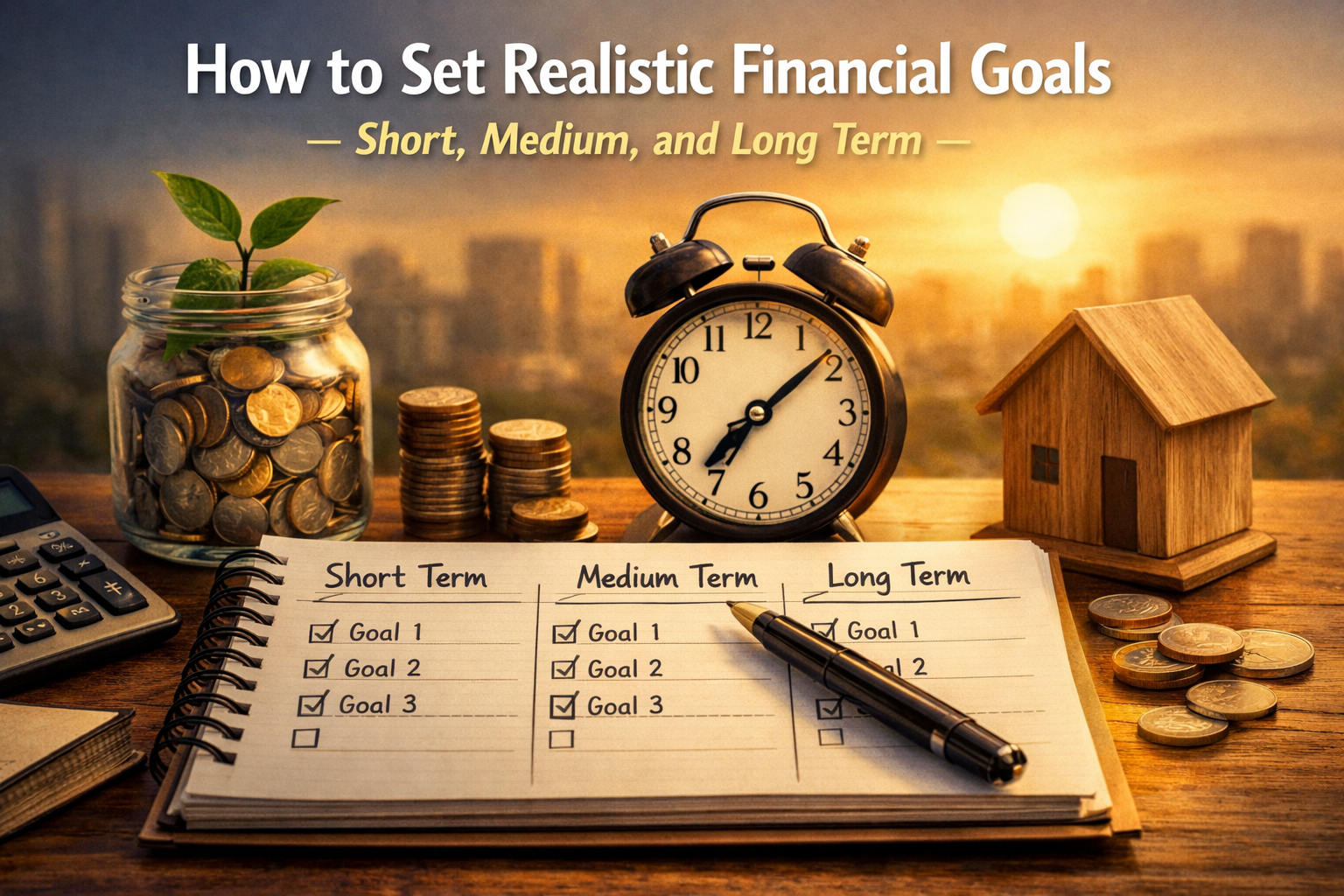

  • How to Set Realistic Financial Goals (Short, Medium, and Long-Term)

    How to Set Realistic Financial Goals (Short, Medium, and Long-Term)

    Realistic Finance Goals: Setting financial goals gives your money direction. Without clear goals, budgeting and saving often feel pointless, which leads many people to quit too early. The problem isn’t lack of discipline—it’s unclear planning.

    In this guide, you’ll learn how to set realistic financial goals that actually work. You will also learn how to categorize them by time frame. Additionally, you will find out how to stay consistent even when income is limited or irregular.


    What Are Financial Goals?

    Financial goals are specific outcomes you want your money to help you achieve. They turn vague intentions like “I want to save money” into clear, actionable plans. Examples include:

    Building an emergency fund

    Paying off debt

    Saving for a home

    Investing for retirement

    If you already understand how budgeting works for beginners, financial goals are what give that budget purpose.


    Why Setting Financial Goals Is Important

    Financial goals help you:

    Stay focused on what truly matters

    Avoid impulse spending

    Measure progress clearly

    Make better financial decisions

    Without goals, money is often spent re-actively instead of intentionally.


    The Three Types of Financial Goals

    To keep goals realistic, divide them into three categories based on time includes: Short-Term, Medium-Term and Long-Term financial goals.


    Short-Term Financial Goals (0–12 Months)

    Short-term goals are things you want to achieve within a year. Examples:

    • Saving $500 for emergencies
    • Paying off a small credit card balance
    • Creating a basic budget

    These goals build confidence and momentum.


    Medium-Term Financial Goals (1–5 Years)

    Medium-term goals take more time and planning.

    Examples:

    • Saving for a car
    • Paying off significant debt
    • Building a 3–6 month emergency fund

    To make progress here, you must balance saving with everyday expenses. Using a simple monthly budgeting method makes this much easier.


    Long-Term Financial Goals (5+ Years)

    Long-term goals focus on your future financial security.

    Examples:

    • Buying a home
    • Saving for retirement
    • Building wealth through investing

    These goals need patience and consistency, not perfection.


    Step-by-Step: How to Set Realistic Financial Goals

    Step 1: Be Specific

    Vague goals lead to vague results. Compare:“I want to save money” to “I want to save $1,000 in 12 months”. Specific goals are easier to track and achieve.


    Step 2: Make Your Goals Measurable

    You should always know: How much you need, how long it will take and how you’ll track progress.This keeps you motivated.


    Step 3: Align Goals With Your Income

    A goal must fit your reality. Setting unrealistic targets often leads to burnout. If your income is tight, start smaller and scale up as things improve.


    Step 4: Prioritize Your Goals

    You can’t work on everything at once. Decide what matters most right now.

    A good order is:

    1. Basic savings
    2. High-interest debt
    3. Long-term goals

    Step 5: Break Big Goals Into Smaller Wins

    Large goals feel overwhelming. Break them into monthly or weekly targets. Small wins create consistency.


    Common Financial Goal Mistakes to Avoid

    Setting Too Many Goals at Once

    This divides your focus and slows progress.

    Comparing Your Goals to Others

    Your financial journey is personal. Focus on what works for you.

    Giving Up Too Early

    Progress is often slow at first. Stay consistent.


    How Often Should You Review Your Financial Goals?

    Review your goals:

    Monthly for short-term goals

    Quarterly for medium-term goals

    Annually for long-term goals

    Adjust as your income and life circumstances change.


    How to Turn Financial Goals Into Daily Action

    Setting goals is only the first step. The real progress happens when those goals influence your daily financial decisions.

    To turn goals into action:

    Align your spending with your priorities

    Say no to expenses that don’t support your goals

    Regularly remind yourself why each goal matters

    When your goals guide your choices, consistency becomes easier.


    How Financial Goals Work Together With Budgeting

    Financial goals and budgeting are not separate systems—they support each other.

    Your budget:

    Tells your money where to go

    Your goals:

    Tell your budget why it matters

    If you’re already using a basic budgeting plan, assign each goal a category inside your budget. This makes progress visible and motivating.


    Examples of Realistic Financial Goals by Income Level

    Low or Irregular Income

    If your income fluctuates, focus on flexibility:

    Saving small, consistent amounts

    Avoiding high-interest debt

    Prioritizing short-term stability

    Even modest goals create powerful habits over time.


    Stable Monthly Income

    With predictable income, you can:

    Automate savings toward multiple goals

    Balance debt payoff and savings

    Plan medium- and long-term goals confidently

    Structure and automation are your biggest advantages.


    Growing Income

    If your income is increasing:

    Increase goal contributions gradually

    Avoid lifestyle inflation

    Revisit long-term goals more often

    Growth is most powerful when paired with intention.


    How to Stay Motivated When Progress Feels Slow

    Financial goals take time, and motivation naturally fades if progress isn’t obvious.

    To stay motivated: Track progress visually, Celebrate small milestones and Focus on habits, not speed.

    Remember, consistency always beats intensity.


    When and How to Adjust Your Financial Goals

    Life changes—and your goals should evolve with it.

    Adjust your goals when: Your income changes, Major life events occur and Expenses increase or decrease.

    Adjusting a goal is not failure; it’s smart financial planning.


    Financial Goals vs. Financial Pressure

    Goals should guide you, not stress you.

    If a goal causes constant anxiety: Reduce the amount, Extend the timeline and Reassess its priority.

    Sustainable goals are better than perfect ones.


    Final Thoughts: Direction Beats Speed

    Financial success is not about moving fast—it’s about moving in the right direction.

    When your goals are clear and realistic, budgeting becomes easier, saving feels purposeful, and financial stress decreases.

    If you already know why budgeting is important, setting strong financial goals is the next step toward long-term stability.


    Frequently Asked Questions

    What is a realistic financial goal?

    A realistic financial goal is one that fits your current income, expenses, and lifestyle while still pushing you toward improvement. It is specific, measurable, and achievable within a clear time frame.

    How many financial goals should I set at once?

    It’s best to focus on one to three goals at a time. Too many goals can divide your attention and reduce progress.

    Can I set financial goals if my income is low?

    Yes. Financial goals are about consistency, not income level. Starting with small, achievable targets builds habits that matter more than the amount saved.

    How often should financial goals be reviewed?

    Short-term goals should be reviewed monthly, medium-term goals quarterly, and long-term goals annually or when major life changes occur.

    What should I prioritize first: savings or debt?

    In most cases, prioritize basic savings first, then high-interest debt. This creates stability while preventing future debt.

  • Emergency Savings Fund in Practice: How to Build, Protect, and Maintain Your Financial Safety Net

    Emergency Savings Fund in Practice: How to Build, Protect, and Maintain Your Financial Safety Net

    An emergency savings fund is often explained in simple terms: money set aside for unexpected expenses. That definition is accurate, but it is also incomplete. Most people don’t struggle because they misunderstand what an emergency fund is. They struggle because they don’t know how to build one realistically, protect it from erosion, and maintain it over time without burnout or guilt.

    This article is designed to complement the core discussion of emergency savings by focusing on the practical and behavioral side of the equation. Instead of re‑defining the concept, we explore how emergency funds actually function in real financial lives, how people unintentionally undermine them, and how to integrate them smoothly into a long‑term money system.

    If you’re still clarifying how much emergency savings you actually need or where that money should be kept safely, our detailed guide on what an emergency savings fund is, how much you need, and where to keep it explains the foundational framework in depth.


    Why Building an Emergency Fund Feels Harder Than It Sounds

    On paper, emergency savings look straightforward. In real life, they compete with rent, groceries, debt payments, family obligations, and the desire to enjoy the present.

    Many households in the United States, the UK, Canada, the EU, and Australia are not irresponsible with money; they are financially stretched. When every dollar already has a job, saving for something that might happen later can feel abstract or even unnecessary.

    There is also a psychological barrier. Emergency funds are invisible when they work well. Nothing exciting happens. The money just sits there. Compared to paying off debt or investing, this can feel unrewarding.

    Understanding these emotional realities is critical. Emergency savings fail most often not because of math, but because of behavior.


    The First Phase: Creating Financial Breathing Room

    Before an emergency fund can grow meaningfully, there must be space for it. This phase is less about savings targets and more about stability.

    For many people, this means reducing financial friction. Small recurring expenses, poorly aligned subscriptions, or inefficient bill timing quietly drain cash flow. Addressing these issues does not require extreme frugality, just awareness.

    This is where emergency savings connect naturally to broader money management concepts explored in Personal Finance Basics. Without a clear picture of where money is going, saving consistently feels impossible.

    Once breathing room exists, even in small amounts, the emergency fund can begin to take shape.


    The Second Phase: Building Without Disruption

    A common mistake is trying to build an emergency fund aggressively and all at once. This often leads to frustration and abandonment.

    Sustainable emergency savings grow quietly. Automatic transfers, modest percentages of income, and irregular boosts from tax refunds or bonuses allow the fund to increase without constant decision‑making.

    At this stage, progress matters more than precision. The goal is not perfection but consistency. Even partial savings reduce risk and increase confidence.

    This approach aligns with long‑term habit formation discussed in How to Build Healthy Money Habits, where systems outperform motivation.


    Protecting the Fund From Everyday Erosion

    One of the biggest threats to emergency savings is not emergencies, but convenience. When the fund is too easy to access, it becomes a fallback for non‑essential spending.

    Keeping emergency savings in a separate account creates a psychological boundary. The money remains accessible, but not casually spendable.

    Clear rules also matter. Defining what qualifies as an emergency ahead of time prevents emotional decisions during stressful moments. When the criteria are clear, using the fund feels responsible rather than indulgent.


    When Using the Emergency Fund Is the Right Decision

    There is often guilt associated with touching emergency savings, even when the situation clearly qualifies. This mindset misunderstands the purpose of the fund.

    Emergency savings exist to be used. Job interruptions, urgent repairs, or uncovered medical costs are not failures; they are the reason the fund exists in the first place.

    Using the fund strategically can prevent far greater financial damage, such as high‑interest debt or forced liquidation of long‑term investments. In this sense, emergency savings quietly support strategies outlined in Smart Ways to Invest Extra Income by protecting invested assets from disruption.


    Rebuilding After an Emergency Without Stress

    After an emergency, many people feel discouraged seeing their savings reduced. This reaction is natural, but it should not derail long‑term progress.

    Rebuilding does not need to happen immediately or aggressively. Once stability returns, contributions can resume gradually. The experience of having the fund work as intended often strengthens commitment rather than weakens it.

    Viewing replenishment as maintenance rather than recovery helps remove emotional pressure.


    Adjusting Emergency Savings as Life Evolves

    Emergency funds are not static. They should change as life changes.

    Career shifts, new dependents, housing changes, or transitions into self‑employment all alter financial risk. A fund that was sufficient at one stage may be inadequate later.

    Periodic review ensures the emergency fund remains aligned with reality rather than past circumstances. This habit prevents quiet under‑preparedness.

    How Emergency Savings Support Financial Confidence

    The true value of an emergency fund often reveals itself indirectly. It shows up in calmer decision‑making, reduced anxiety, and the ability to respond rather than react.

    People with emergency savings tend to approach money with more patience. They are less pressured by short‑term setbacks and more capable of sticking to long‑term plans.

    This confidence is not about wealth. It is about preparedness.


    Emergency Savings as a Living Part of Your Financial System

    An emergency savings fund is not a one‑time project. It is a living component of a broader financial structure.

    It works alongside budgeting, insurance, and investing to absorb shocks and protect momentum. When integrated thoughtfully, it becomes almost invisible, quietly doing its job in the background.

    Rather than duplicating foundational explanations, this perspective highlights why emergency savings succeed or fail in real life. The fund’s power lies not in how it is defined, but in how it is used, protected, and maintained over time.


    Frequently Asked Questions

    How do I start an emergency savings fund if my income is already tight?

    Start small and focus on consistency rather than amount. Even modest, regular contributions create financial breathing room over time. The goal is to reduce risk gradually, not to reach a perfect number immediately.

    Should I stop investing until my emergency savings fund is fully built?

    Not necessarily. Many beginners build emergency savings while making small, steady contributions to long-term investments. What matters is balance. Without some emergency savings, investments are more vulnerable to disruption during unexpected events.

    What counts as a real emergency when using this fund?

    A true emergency is an unexpected, necessary expense that can’t be postponed without causing harm, such as job loss, urgent medical costs, or essential repairs. Predictable or discretionary expenses should not come from emergency savings.

    Is it okay to use my emergency fund and then rebuild it later?

    Yes. Using your emergency fund for its intended purpose is not a failure. Once stability returns, you can gradually rebuild it. The fact that the fund worked as designed is a sign of success, not a setback.

    How often should I review or adjust my emergency savings fund?

    It’s a good idea to review your emergency fund whenever your life changes, such as a new job, higher expenses, or added responsibilities. Periodic reviews help ensure your savings still match your current level of financial risk.